








Can a Football Tipster Profit With a Low Win Rate?
< Back to Blog
Can a Football Tipster Profit With a Low Win Rate?
Date : October 21,2026
Categories :
Can a Tipster Be Profitable While Being Wrong Most of the Time?
Most football bettors believe a good tipster should win more bets than they lose. A 75% win rate sounds impressive, while a tipster winning only 35% of their predictions might appear unsuccessful. But here's something many bettors overlook: a tipster can lose most of their bets and still make a profit. The secret isn't necessarily predicting more winners. It's understanding the relationship between winning probability, betting odds and long-term returns.
Why Win Rate Doesn't Tell the Full Story
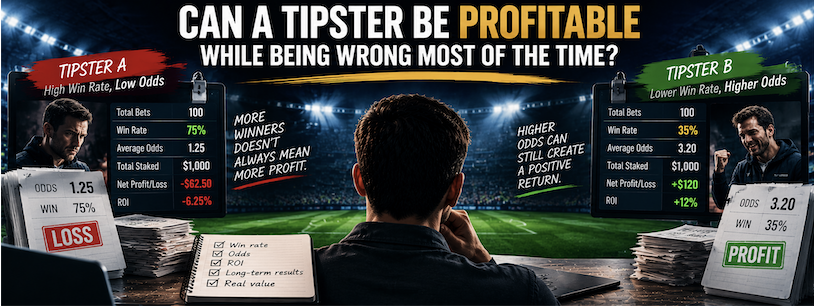
Imagine two football tipsters with completely different strategies. Tipster A focuses on heavy favorites, while Tipster B specializes in higher-odds underdogs. After 100 bets, their results look like this:
|
Performance |
Tipster A |
Tipster B |
|---|---|---|
|
Total Bets |
100 |
100 |
|
Winning Bets |
75 |
35 |
|
Losing Bets |
25 |
65 |
|
Average Winning Odds |
1.25 |
3.20 |
|
Total Staked |
$1,000 |
$1,000 |
|
Net Profit/Loss |
-$62.50 |
+$120 |
|
ROI |
-6.25% |
+12% |
Illustrative example assuming $10 flat stakes and identical odds for each tipster's winning bets. Despite winning 75% of their selections, Tipster A loses money. Meanwhile, Tipster B gets 65 predictions wrong but finishes with a 12% return. This demonstrates why win rate alone can be misleading.
The Break-Even Point Matters More
Every set of betting odds has a break-even win rate.
For example:
-
Odds of 1.50 require a win rate above 66.7%.
-
Odds of 2.00 require a win rate above 50%.
-
Odds of 3.00 require a win rate above 33.3%.
-
Odds of 4.00 require a win rate above 25%.
These figures assume ordinary win-or-lose bets without pushes or partial settlements. A tipster consistently betting at odds of 3.50 doesn't need to win half their selections to be profitable. They need to win more than approximately 28.6% of them. That's why professional tipsters pay attention to the odds they receive rather than simply chasing a high percentage of winners.
Why Some Tipsters Prefer Underdogs
Higher-odds selections naturally lose more frequently. A tipster specializing in underdogs might experience several consecutive losses before finding a winner. To casual followers, that can look like poor performance. But if the tipster consistently identifies teams whose actual winning chances are higher than the market implies, the strategy may have positive expected value.
For example, suppose an underdog has an estimated 35% chance of winning, but the bookmaker offers odds of 3.20. Those odds imply a break-even probability of 31.25%. If the tipster's 35% estimate is accurate, the bet offers a theoretical advantage. However, identifying that advantage consistently is difficult. Higher odds don't automatically mean better value.
Why Losing Streaks Can Be Misleading
Imagine following a tipster who wins approximately one out of every three bets. It's entirely possible to experience five, six or more consecutive losses even if the strategy has a genuine edge. This is why judging a tipster after ten selections can be dangerous. A profitable strategy may look terrible over a short period, while an unprofitable strategy can temporarily produce impressive results. Instead of reacting to every losing streak, examine the tipster's performance across a meaningful sample. Pay attention to ROI, average odds, total selections, bankroll drawdown and whether the recommended prices remain competitive. Even hundreds of bets may not conclusively prove an edge, particularly when outcomes have high variance.
What Should You Look for in a Profitable Tipster?
When comparing football tipsters, don't automatically choose the one advertising the highest win rate. A more useful evaluation considers three things.
First, profitability. Has the tipster produced positive returns after accounting for all recorded stakes and losses?
Second, consistency. Are those results supported by a substantial, transparent betting history rather than a handful of successful predictions?
Third, value. Does the tipster regularly identify attractive odds, and do their selections demonstrate evidence of an advantage over the market?
A tipster winning 40% of selections at attractive prices may be more valuable than someone winning 80% at extremely short odds. The numbers need to be evaluated together.
Final Thoughts
A high win rate might look impressive, but it doesn't guarantee profitability. Likewise, a tipster who loses most of their predictions isn't necessarily unsuccessful. What matters is whether the returns from winning bets exceed the cost of losing ones over time. Before judging a football tipster, look beyond how often they're right. Examine the odds, ROI, sample size and long-term performance.
Because in football betting, being right more often doesn't always mean making more money.
Tags :RECENT POST
CATEGORIES
- Betting Guide
- Betting Help
- Betting Strategy
- Sports Betting
- Sportsbook
- Profitable Trends
- Soccer Players
- World Cup
- Betting Tips
- Team Reviews
- Player Analysis
- League Reviews
- Club Reviews
- Betting Market
- Manager Reviews
- Match Preview
- Transfers
- Soccer Betting
- Soccer Picks Web Series
- Betting System
- Betting Trends Web Series
- Players Analysis
- League review
- Southamerican soccer
- Betting markets
- Casino Betting
tags