








Why a 9/10 Football Tip Isn't a 90% Win Chance
< Back to Blog
Why a 9/10 Football Tip Isn't a 90% Win Chance
Date : October 12,2026
Categories :
The Confidence Score Problem: Why a 9/10 Tip Doesn't Mean a 90% Chance of Winning
You've probably seen football tipsters publish predictions with impressive confidence ratings.
Manchester United to Win – Confidence: 9/10
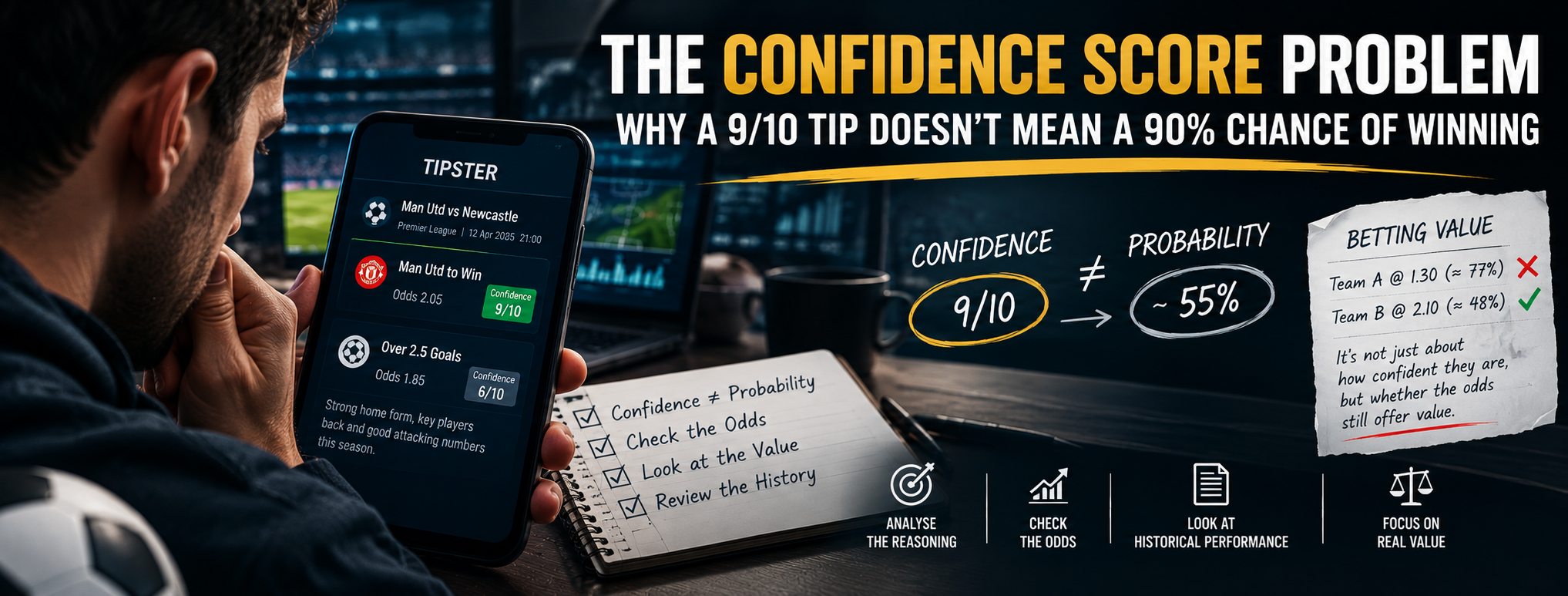
It looks convincing. A 9/10 rating sounds like the tipster believes there's a 90% chance of winning. But here's the problem: confidence and probability aren't necessarily the same thing. A tipster can be extremely confident in a selection that has only a 55% chance of winning. Understanding this difference is essential when evaluating football predictions.
What Does a 9/10 Confidence Rating Actually Mean?
Unlike betting odds, confidence scores don't follow a universal standard. One tipster might use 9/10 to indicate a strong statistical advantage. Another might use it because the team is in excellent form. Someone else might simply be expressing personal conviction. Without a clear explanation, the number tells you very little.
Consider two predictions:
-
Tipster A: Home Win @ 1.25 – Confidence 9/10
-
Tipster B: Away Win @ 2.80 – Confidence 9/10
Both carry identical confidence ratings, but the odds imply very different probabilities. At 1.25, the implied probability is 80%. At 2.80, it's approximately 35.7%. The same confidence rating clearly cannot be interpreted as the same winning probability unless the tipster has explicitly defined it that way.
Why High Confidence Doesn't Guarantee a Good Bet
One of the biggest mistakes bettors make is assuming that a highly confident prediction must offer good value. Imagine a tipster believes a team has a 70% chance of winning. The bookmaker offers odds of 1.30, implying a probability of approximately 76.9%. Even if the tipster feels extremely confident, the available price doesn't support a profitable bet based on that estimate. Now imagine another selection with a 55% estimated winning probability at odds of 2.10.
That second prediction might carry a lower confidence rating, yet offer better mathematical value. A strong prediction and a valuable bet are two different things. Professional tipsters understand that the relationship between probability and price matters more than how confident a selection feels.
The Psychology Behind Confidence Ratings
Confidence scores are attractive because they simplify complicated decisions. A bettor scrolling through dozens of predictions may naturally prefer a 9/10 selection over a 6/10 selection. But this creates a dangerous shortcut.
Instead of examining the odds, statistics and reasoning, followers begin treating confidence ratings as guarantees. There's also a psychological issue for tipsters themselves. When someone publicly labels a prediction 10/10, they may become reluctant to acknowledge uncertainty or change their opinion when new information appears.
Good analysis requires flexibility, not absolute conviction.
How to Evaluate Confidence Properly
Rather than relying on a confidence score alone, examine the evidence behind the recommendation. Start with the tipster's historical performance. Have their previous high-confidence selections actually performed better than their lower-confidence picks? If a tipster claims that 9/10 represents a 90% winning probability, that claim should be tested against a substantial history of predictions.
For example, if 200 selections rated 9/10 produced only 120 wins, the actual win rate would be 60%, not 90%.
That would indicate the ratings are poorly calibrated as probabilities. Also consider the average odds, ROI and the specific markets involved. A tipster can have a high win rate while still losing money if the odds are consistently too short. Most importantly, ask whether the tipster provides a clear methodology for assigning confidence ratings. A transparent rating system is more useful than an impressive number without an explanation.
What Professional Tipsters Should Communicate Instead
A useful football prediction should explain more than confidence. Ideally, it should provide the recommended selection, available odds, reasoning and an assessment of risk.
For example:
Selection: Over 2.5 Goals
Odds: 1.95
Estimated Probability: 56%
Reasoning: Both teams consistently create high-quality chances, while their defensive performances suggest opportunities at both ends.
This gives followers something measurable. At odds of 1.95, the break-even probability is approximately 51.3%. If the estimated 56% probability is accurate, the selection may offer value. Of course, the probability estimate itself could still be wrong. But at least the reasoning can be evaluated.
Final Thoughts
A 9/10 confidence rating might indicate strong conviction, but it doesn't automatically mean a 90% chance of winning. Confidence is an opinion unless it's backed by a clearly defined and historically tested probability model. When evaluating football tipsters, focus on their reasoning, odds, long-term records and transparency rather than impressive confidence scores. Because in football betting, being confident is easy. Being accurately confident is much harder.
Tags :RECENT POST
CATEGORIES
- Betting Guide
- Betting Help
- Betting Strategy
- Sports Betting
- Sportsbook
- Profitable Trends
- Soccer Players
- World Cup
- Betting Tips
- Team Reviews
- Player Analysis
- League Reviews
- Club Reviews
- Betting Market
- Manager Reviews
- Match Preview
- Transfers
- Soccer Betting
- Soccer Picks Web Series
- Betting System
- Betting Trends Web Series
- Players Analysis
- League review
- Southamerican soccer
- Betting markets
- Casino Betting
tags