








Tipster Decay: Why Betting Edges Disappear
< Back to Blog
Tags :
Tipster Decay: Why Betting Edges Disappear
Date : September 02,2026
Categories :
Tipster Decay: Why a Winning Betting Edge Doesn't Last Forever
Finding a profitable football tipster is difficult. Finding one who stays profitable for years is even harder. A tipster might dominate a particular league or market for an entire season, producing strong ROI and consistently finding attractive odds. Then, gradually, the results begin to weaken. This doesn't necessarily mean the original success was luck.
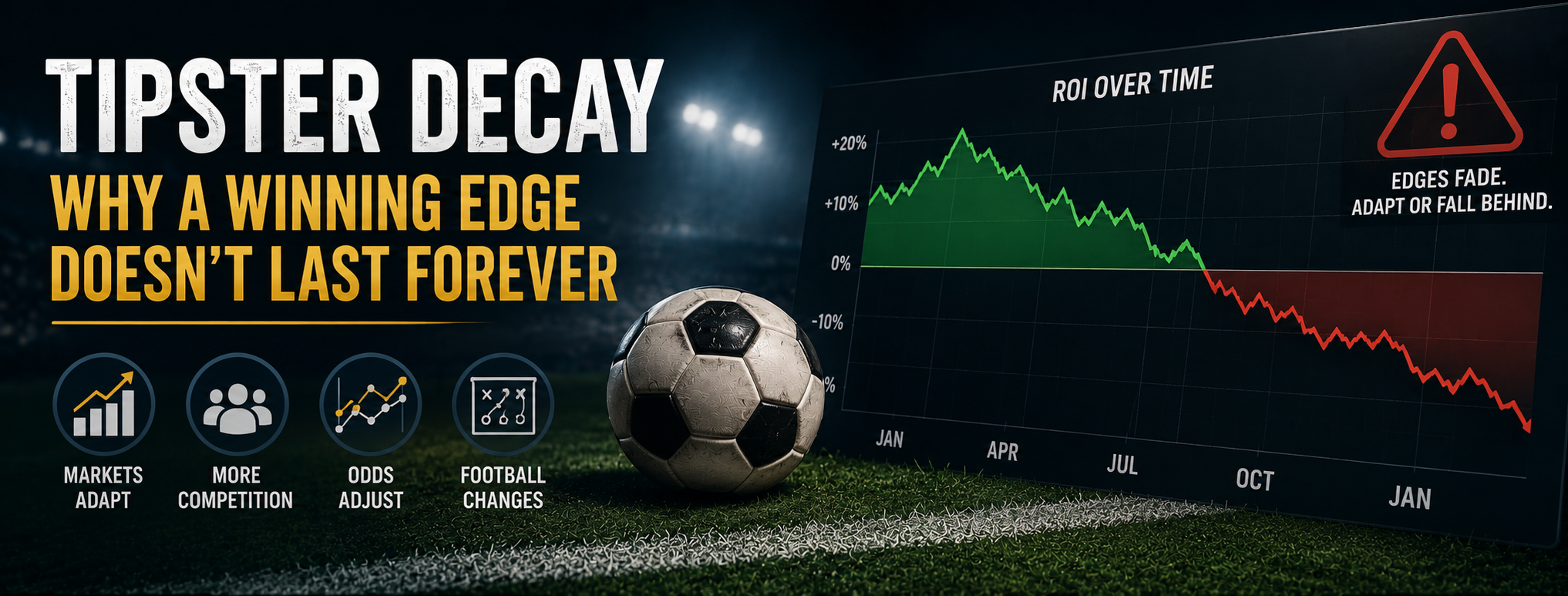
The tipster may be experiencing tipster decay: the gradual weakening of a betting edge as markets, bookmakers, teams and information change. Understanding this is important because yesterday's winning strategy isn't automatically tomorrow's winning strategy.
What Is a Betting Edge?
A betting edge exists when a tipster can identify situations where the available odds don't accurately reflect the probability of an outcome. For example, a tipster repeatedly identifies teams priced around 2.20 that they believe should be closer to 1.90. If their assessment is consistently better than the market's, they have an edge. But betting markets aren't static. Once profitable patterns become easier to identify, prices can adjust.
Why Successful Strategies Can Stop Working
Imagine a tipster discovers that bookmakers consistently underestimate away teams in a particular league. For months, they exploit it successfully. Eventually, several things can happen. Bookmakers improve their models. Other professional bettors discover the same pattern. More money enters those selections. Odds adjust faster. The opportunity may still exist occasionally, but the easy advantage disappears. The strategy hasn't necessarily become "wrong." The market has simply caught up.
More Bettors Can Reduce the Value
Successful tipsters can sometimes become victims of their own popularity. Suppose a relatively unknown tipster releases a selection at 2.10. Very little happens. Now imagine that same tipster has thousands of followers.
The moment the selection appears, followers begin betting it. The odds move:
2.10 → 2.00 → 1.90 → 1.82.
The original recommendation may have contained excellent value at 2.10. Someone following later at 1.82 isn't necessarily receiving the same opportunity. The tipster's prediction hasn't changed. The price has.
Football Changes Too
Markets aren't the only thing evolving. Football itself changes constantly. Managers change. Tactical trends develop. Teams change recruitment strategies. Competition formats evolve. Data becomes more widely available. A tipster who built an advantage around one specific pattern must continuously test whether that pattern still exists. This is why strong tipsters adapt rather than simply repeating what worked last season.
How Can You Spot Tipster Decay?
A few losing weeks aren't enough. Every legitimate betting strategy experiences variance. Instead, look for longer-term changes. A tipster who historically secured better prices than the closing market may stop doing so. ROI may gradually decline across several hundred selections. Their strongest leagues may become less profitable. Their recommended odds may move against them more frequently. Those signals deserve investigation. The important thing is distinguishing a temporary losing streak from deterioration in the underlying edge.
Don't Judge Tipsters Only by Lifetime Results
Suppose a tipster shows:
1,000 bets
+12% lifetime ROI
That sounds excellent. But what if most of that profit came from the first 400 bets? Perhaps their recent 600 bets generated only 1% ROI. The lifetime number is technically correct, but it hides an important trend. When evaluating a tipster, look at both long-term performance and recent rolling performance. You want to know not only whether they had an edge, but whether there is evidence that the edge still exists.
The Best Tipsters Keep Evolving
Long-term successful tipsters don't necessarily use exactly the same strategy forever.
-
They test assumptions.
-
They monitor results.
-
They study market movement.
-
They adjust which leagues and markets they specialize in.
Most importantly, they are willing to stop using an approach when the evidence suggests the advantage has disappeared. Adaptability can be just as important as prediction ability.
Final Thoughts
A winning betting strategy doesn't come with permanent ownership of an edge. Markets learn. Bookmakers improve. Information spreads. Football changes. That's why bettors shouldn't follow a tipster purely because they produced spectacular results several years ago. Study whether their performance remains consistent, whether they're still finding strong prices and whether their strategy continues to evolve.
Finding an edge is difficult.
Keeping one is even harder.
And sometimes the biggest skill of a professional tipster is recognizing when an old advantage no longer exists.
Tags :
RECENT POST
CATEGORIES
- Betting Guide
- Betting Help
- Betting Strategy
- Sports Betting
- Sportsbook
- Profitable Trends
- Soccer Players
- World Cup
- Betting Tips
- Team Reviews
- Player Analysis
- League Reviews
- Club Reviews
- Betting Market
- Manager Reviews
- Match Preview
- Transfers
- Soccer Betting
- Soccer Picks Web Series
- Betting System
- Betting Trends Web Series
- Players Analysis
- League review
- Southamerican soccer
- Betting markets
- Casino Betting
tags