








The 100-Bet Audit: How to Verify a Tipster's Record
< Back to Blog
The 100-Bet Audit: How to Verify a Tipster's Record
Date : November 24,2026
Categories :
The 100-Bet Audit: How to Tell If a Tipster's Winning Record Is Real
A football tipster advertises an 80% win rate, impressive monthly profits and screenshots of winning selections. Everything looks convincing. But how much of that performance can actually be verified? Rather than relying on promotional claims, bettors can conduct a simple 100-bet audit. By examining 100 consecutive selections, you can develop a clearer picture of a tipster's transparency, profitability and credibility. It won't prove that a tipster has a permanent betting edge, but it can reveal problems that headline statistics often hide.
Start With 100 Consecutive Bets
The keyword here is consecutive. Don't allow the tipster to choose their best 100 predictions or their most profitable month. Instead, examine 100 consecutive selections from a defined period, including every win, loss, void and partial settlement. Each selection should contain the original publication date, match, betting market, recommended odds, stake and final result. Predictions should also have been recorded before kickoff. Without reliable timestamps, it becomes difficult to establish whether selections were genuinely published before the outcome was known.
A credible betting record should be complete, not selectively presented.
Recalculate the Actual Profit
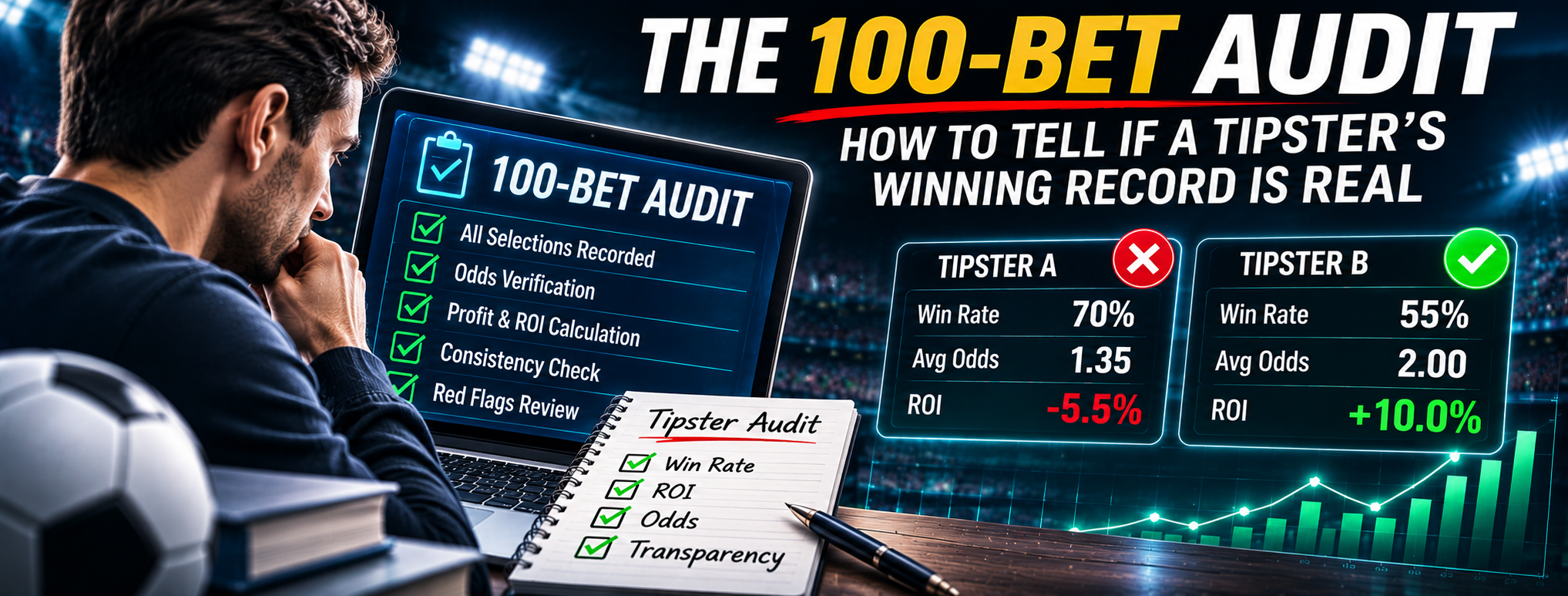
Win rate is one of the easiest statistics to promote, but it doesn't necessarily reflect profitability. Consider the following hypothetical audit of two tipsters, using one unit per bet and identical odds for each tipster's winning selections.
| Performance | Tipster A | Tipster B |
|---|---|---|
| Total Bets | 100 | 100 |
| Wins | 70 | 55 |
| Losses | 30 | 45 |
| Average Winning Odds | 1.35 | 2.00 |
| Total Staked | 100 Units | 100 Units |
| Net Profit/Loss | -5.5 Units | +10 Units |
| ROI | -5.5% | +10% |
Illustrative performance data for comparison purposes only.
Tipster A has a significantly higher win rate but finishes with a loss. Tipster B wins fewer predictions but generates a positive return. This is why an audit should independently calculate profit and ROI rather than accepting advertised success rates.
Verify Whether the Odds Were Realistic
A tipster's record might show excellent returns, but could their followers realistically obtain the recommended odds? Imagine a tipster consistently records selections at 2.10, while most followers can only access 1.85 by the time the predictions are published. That difference can significantly affect profitability over 100 bets. Where historical odds data is available, compare the recorded prices with the actual market prices around the publication time. Be particularly cautious when a tipster repeatedly claims unusually attractive odds without identifying the bookmaker or recording when those prices were available. A profitable record is less meaningful if the prices cannot reasonably be replicated.
Look for Hidden Warning Signs
A 100-bet audit can reveal suspicious patterns that aren't immediately obvious from a performance summary.
Common warning signs include:
- Losing predictions disappearing from historical records.
- Recommended odds being edited after publication.
- Stake sizes being changed after results are known.
- Incorrect settlement of Asian Handicap or Total Goals bets.
- Profitable periods being promoted while losing periods are excluded.
An isolated recording error doesn't necessarily indicate dishonesty. However, repeated inconsistencies deserve closer examination. Transparency matters just as much as performance.
Check Where the Profits Come From
Suppose a tipster finishes 100 bets with a profit of 15 units. That sounds impressive, but what if 12 units came from just two high-odds winners? The record may be genuine, yet the results could be heavily influenced by a small number of outcomes. Examine how profits are distributed across the sample. Look at performance by league, betting market, odds range and time period. A positive result supported by a broad range of selections may provide more useful evidence than one driven entirely by a few exceptional wins. However, even consistent-looking results can occur through chance.
Is 100 Bets Enough to Trust a Tipster?
One hundred bets is a useful starting point for evaluating credibility, but it is not enough to conclusively establish long-term profitability. A genuine tipster can experience a losing period across 100 selections. Equally, an unprofitable tipster can enjoy a successful run through statistical variance. The purpose of the audit is to establish whether the record is transparent, mathematically accurate and worth investigating further. When comparing tipsters on Betfame, consider longer historical records, relevant market expertise, realistic odds and risk exposure alongside the initial audit.
Final Thoughts
A tipster's reputation should be supported by evidence, not screenshots, testimonials or impressive marketing claims. The 100-bet audit provides a practical way to look beyond advertised win rates and examine the actual numbers behind a tipster's performance. Verify the selections. Recalculate the returns. Check the odds. Examine the inconsistencies. No historical record guarantees future profits, but a transparent one allows you to make a more informed assessment.
A credible tipster shouldn't just show you their winners. They should be willing to show you everything.
Tags :RECENT POST
CATEGORIES
- Betting Guide
- Betting Help
- Betting Strategy
- Sports Betting
- Sportsbook
- Profitable Trends
- Soccer Players
- World Cup
- Betting Tips
- Team Reviews
- Player Analysis
- League Reviews
- Club Reviews
- Betting Market
- Manager Reviews
- Match Preview
- Transfers
- Soccer Betting
- Soccer Picks Web Series
- Betting System
- Betting Trends Web Series
- Players Analysis
- League review
- Southamerican soccer
- Betting markets
- Casino Betting
tags