








The Tipster–Market Gap: Expert vs Odds
< Back to Blog
Tags :
The Tipster–Market Gap: Expert vs Odds
Date : August 27,2026
Categories :
The Tipster–Market Gap: When Should You Trust the Expert Over the Odds?
You find a tipster you trust. Their analysis says the underdog is seriously undervalued.
Then you check the market.
The bookmakers strongly favor the other team.
Who should you believe?
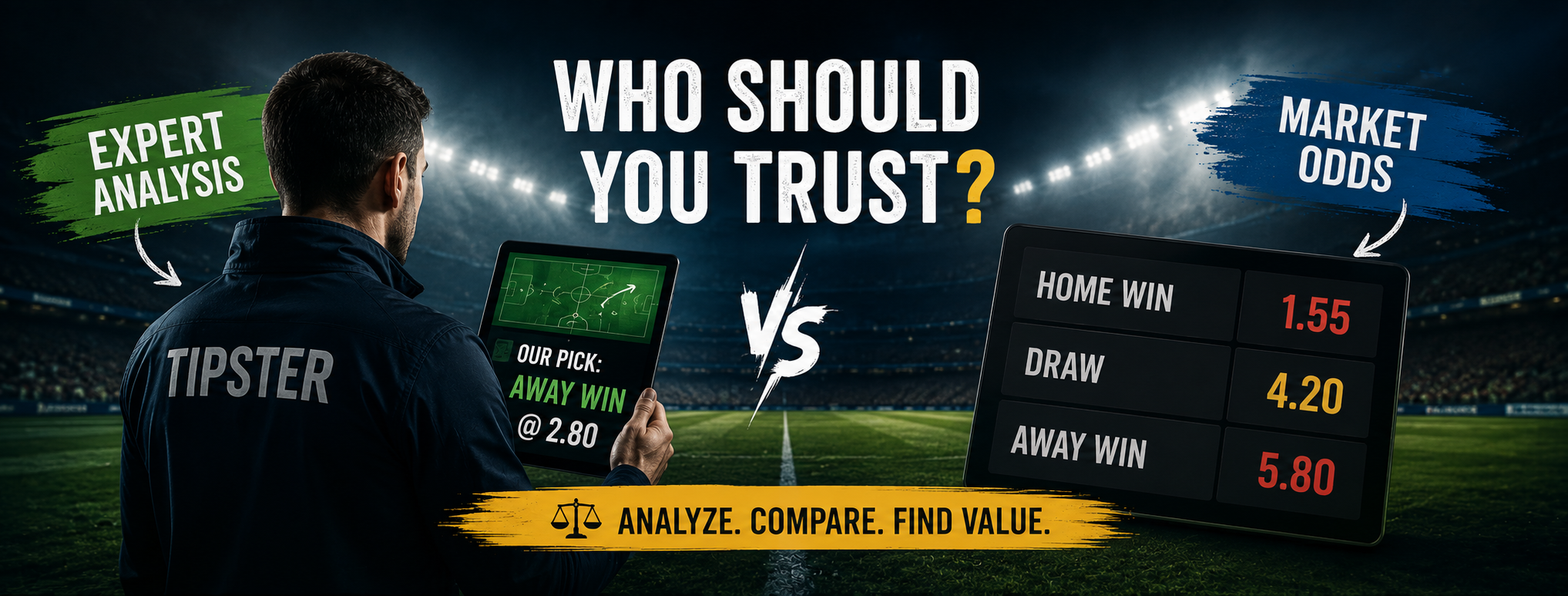
This disagreement is what we can call the tipster–market gap: the difference between how an expert evaluates a match and how the betting market prices it.
Sometimes that gap represents genuine value. Other times, the market knows something the tipster has missed.
Knowing the difference is an important skill.
The Market Is Powerful, But It Isn't Perfect
Football odds aren't created randomly. They begin with bookmaker models and are continuously influenced by betting activity, team news, injuries, lineups and other information.
By kickoff, major football markets can be highly efficient.
That means disagreeing with the market shouldn't be taken lightly.
If you believe a team should be 2.00 but the market offers 2.80, don't immediately celebrate the "huge value."
First ask:
Why is the market giving me 2.80?
There may be an opportunity. There may also be something you've overlooked.
When a Tipster May Know Better
Markets process enormous amounts of information, but specialist knowledge can still create an advantage.
Imagine a tipster who has spent years covering one smaller European league. They understand local team news, tactical changes, squad depth and coaching tendencies that receive little attention from mainstream bettors.
Their assessment may occasionally identify something the broader market hasn't fully priced yet.
This is particularly interesting when the tipster has a proven history in that exact league or market.
A Premier League specialist disagreeing with the market on an obscure second-division match means relatively little.
A specialist with hundreds of tracked bets in that competition deserves more attention.
Timing Changes Everything
You also need to know when the tipster made the prediction.
Suppose a tipster recommends Team A at 2.40 on Monday.
By Saturday, Team A is 1.95.
The tipster and the market may no longer disagree at all. The market eventually moved toward the tipster's original assessment.
But if you only discover the selection on Saturday, copying it at 1.95 is a completely different bet.
This is why serious bettors track the price at which a recommendation was originally made—not simply whether the prediction eventually won.
A Big Disagreement Should Trigger Research, Not Confidence
One of the worst reactions to a large tipster–market gap is:
"The bookmakers have got this completely wrong."
Maybe.
But the larger the disagreement, the more carefully you should investigate it.
Check whether there are injuries, expected rotations, unusual scheduling circumstances or tactical issues that could explain the price.
Then examine the tipster.
Is this one of their specialist markets? Do they regularly find value at similar odds? Have their previous selections tended to move in the same direction before kickoff?
The gap itself isn't a reason to bet.
It's a reason to investigate.
Watch What Happens After the Tip
Market movement can provide another useful clue.
Imagine a respected tipster recommends an underdog at 3.10.
Over the next day:
3.10 becomes 2.90.
Then 2.75.
Eventually, it closes around 2.60.
The match could still lose, but the market has moved significantly toward the tipster's original position.
Now consider the opposite.
The tipster recommends 3.10, but the market moves to 3.60.
That doesn't automatically make the tipster wrong, but it's worth asking why the wider market is moving the other way.
Over time, these patterns can help you evaluate whether a tipster is genuinely identifying mispriced odds.
Don't Turn Experts Into Oracles
Trusting a good tipster doesn't mean assuming they know more than the entire market every time.
Even excellent tipsters will:
-
Misread matches
-
Miss information
-
Experience losing periods
-
Overestimate an edge
The goal isn't to choose between "the tipster is right" and "the bookmaker is right."
The smarter approach is to use both.
A tipster provides analysis.
The market provides a price.
Your job is to decide whether the difference between them creates an opportunity worth taking.
So, When Should You Trust the Expert?
A disagreement becomes more interesting when several things are present: the tipster has a strong long-term record, they're operating inside their area of specialization, the reasoning is clear, the recommended odds still exist, and there is no obvious information explaining why the market disagrees.
Even then, nothing is guaranteed.
You're simply making a calculated decision that the expert may have identified something the market hasn't priced correctly yet.
Final Thoughts
The betting market deserves respect, but not blind obedience. Good tipsters deserve trust, but not blind loyalty either.
When the two disagree, don't automatically choose a side.
Study the gap.
Ask why it exists, whether the tipster has expertise in that situation, what has happened to the odds since the recommendation and whether the available price still represents value.
Sometimes the market is telling the tipster they're wrong.
Sometimes the tipster is simply early.
Learning to recognize the difference is where things become interesting.
Tags :
RECENT POST
CATEGORIES
- Betting Guide
- Betting Help
- Betting Strategy
- Sports Betting
- Sportsbook
- Profitable Trends
- Soccer Players
- World Cup
- Betting Tips
- Team Reviews
- Player Analysis
- League Reviews
- Club Reviews
- Betting Market
- Manager Reviews
- Match Preview
- Transfers
- Soccer Betting
- Soccer Picks Web Series
- Betting System
- Betting Trends Web Series
- Players Analysis
- League review
- Southamerican soccer
- Betting markets
- Casino Betting
tags