








Why Football Odds Matter More Than Predictions
< Back to Blog
Tags :
Why Football Odds Matter More Than Predictions
Date : August 22,2026
Categories :
Why Odds Are More Honest Than Football Predictions
Football predictions are everywhere. Before a major match, fans, analysts, influencers and tipsters all have an opinion about what will happen. One person says the home team will dominate. Another predicts an upset. Someone else is convinced the match will end in a draw.
Odds work differently.
They don't tell you what will happen. They tell you how the market is pricing what could happen. That distinction is important. If you want to understand football betting at a deeper level, learning to read the odds can sometimes tell you more than reading another prediction.
Predictions Are Opinions. Odds Are Prices.
A prediction might say:
"Team A should win tonight."
That sounds useful, but it leaves out an important question: at what price? Imagine Team A has roughly a 60% chance of winning. Fair decimal odds would be around 1.67. If the available odds are 1.90, there may be value. If they're only 1.35, the same team can still be the most likely winner while being an unattractive bet. This is why professional tipsters don't simply search for winners. They compare probability with price.
Odds Force the Market to Put a Number on an Opinion
Saying "I think Arsenal will win" costs nothing. Pricing Arsenal at 1.70 is different. A price forces probability into the discussion. Bookmakers open markets based on models, information and expected betting behavior. Bettors then react, and prices can move as new information and money enter the market. The result isn't perfect. Bookmakers can be wrong, and markets can overreact. But odds provide something predictions often don't: a measurable price.
The Favorite Isn't Automatically the Best Bet
This is one of the most important lessons odds can teach you.
Suppose the market offers:
-
Favorite: 1.30
Draw: 5.50
Underdog: 9.00
The market clearly believes the favorite is much more likely to win. But that doesn't automatically mean 1.30 is worth betting. If the team's true chance is lower than the price implies, the favorite may be overpriced. Meanwhile, the underdog or another market could offer better value.
Professional bettors separate two questions:
"Who is most likely to win?"
and
"Which price offers the best opportunity?"
Those questions can produce completely different answers.
Odds Movement Can Reveal Changing Information
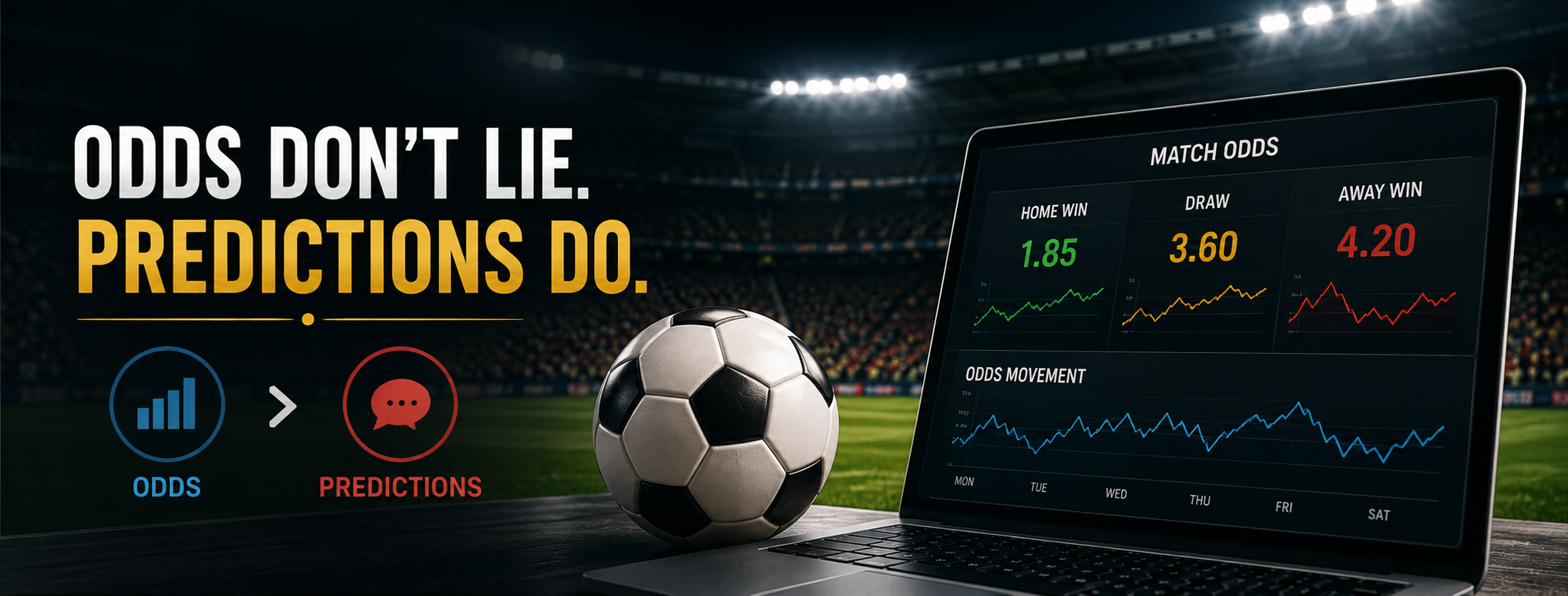
The opening price is only part of the story. Imagine a team opens at 2.20 on Monday and trades around 1.85 by Saturday. Something has changed. Perhaps an important player returned from injury. Maybe the opponent lost its starting goalkeeper. Perhaps influential bettors considered the original price too high. The movement itself doesn't prove which team will win, but it tells you that the market's assessment has changed. That information is often more useful than a confident prediction posted without any reference to price.
Good Tipsters Respect the Market
Strong tipsters don't need to agree with bookmakers. In fact, finding situations where the market may be wrong is part of the job. But good tipsters usually understand what they're disagreeing with. If a tipster believes a team should be priced at 2.00 while bookmakers offer 2.50, there is a clear argument: the tipster believes the market has underestimated that team's probability.
Compare that with:
"This team is guaranteed to win."
One statement can be tested against the market. The other is simply confidence.
Closing Odds Can Help Evaluate Your Decisions
One useful way to evaluate betting decisions is to compare your entry price with the closing market. Suppose you take 2.30 and the same selection closes at 1.95. The match could still lose. Football is unpredictable. But consistently securing prices that later shorten can indicate that your analysis is identifying value before the wider market adjusts. That's a much more meaningful long-term signal than judging your ability from the result of one match.
Odds Aren't Always Right
None of this means you should blindly trust bookmakers. Odds contain bookmaker margins. Markets can follow public sentiment. Popular teams can attract disproportionate attention, and unexpected information can change everything. The point is not that odds predict football perfectly. It's that they communicate information more precisely than a simple "win", "lose" or "draw" prediction. A prediction tells you what someone thinks. Odds tell you what that opinion is worth at the current price.
Final Thoughts
Football predictions are useful, particularly when they come from knowledgeable analysts and proven tipsters. But predictions become much more meaningful when they're considered alongside the odds. Don't only ask who will win. Ask what probability the price represents, whether that probability makes sense, how the market has moved and whether you're receiving enough value for the risk. The smartest football bettors aren't trying to predict every match correctly. They're trying to recognize when the price and the probability don't match.
Tags :
RECENT POST
CATEGORIES
- Betting Guide
- Betting Help
- Betting Strategy
- Sports Betting
- Sportsbook
- Profitable Trends
- Soccer Players
- World Cup
- Betting Tips
- Team Reviews
- Player Analysis
- League Reviews
- Club Reviews
- Betting Market
- Manager Reviews
- Match Preview
- Transfers
- Soccer Betting
- Soccer Picks Web Series
- Betting System
- Betting Trends Web Series
- Players Analysis
- League review
- Southamerican soccer
- Betting markets
- Casino Betting
tags